
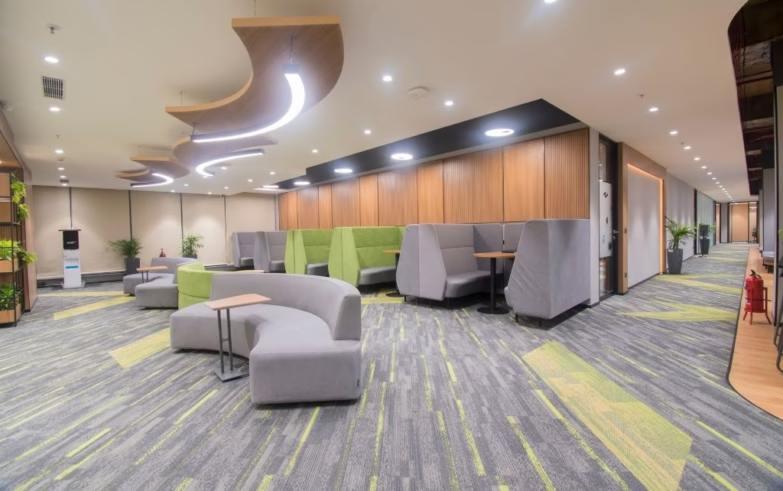
For years, office design was largely treated as an operational requirement. A company needed workstations, meeting rooms, cabins, reception areas and enough space for its employees. The objective was usually simple: create a functional workplace within the allocated budget.
But the role of the workplace has changed.
Today, a corporate office is much more than a place where employees come to work. It is where teams collaborate, ideas are exchanged, clients are welcomed, company culture is experienced and brands come to life. As organisations rethink how people work and interact, the physical workplace is becoming an increasingly important part of the larger business strategy.
This is where corporate office design is undergoing a significant shift. The conversation is moving beyond how an office looks to what it enables. A well-planned workplace can influence employee experience, collaboration, brand perception, space utilisation, sustainability and the organisation’s ability to adapt.
The question is no longer simply, “How much will our office cost?” It is increasingly becoming, “What value should our workplace create for the business?”
The Office Is Now Part of the Business Strategy
A successful workplace does more than create an attractive environment. It should support the way an organisation actually functions.
Every business has different requirements. Some teams need quiet spaces for focused work, while others depend heavily on collaboration. Leadership teams may require private meeting rooms, while larger organisations may need flexible spaces that can accommodate changing team sizes and working patterns.
This is why effective workplace design should begin with understanding the business rather than selecting furniture or colours.
How do employees work? Where does collaboration happen? Which activities require privacy? How frequently do teams meet in person? How often do clients visit? What should the workplace communicate about the organisation?
These questions help create a design that is relevant to the business rather than simply following a generic office template.
In this context, corporate office interior design becomes much more than the visual treatment of a space. It becomes a way of translating business requirements into a physical environment.
Employee Experience Starts With the Workplace
Employee experience is shaped by many factors, and the physical environment is one of them.
Employees spend a significant part of their working lives in the workplace. The quality of lighting, acoustics, furniture, temperature, spatial planning and access to natural elements can influence how comfortable and functional that environment feels.
A poorly planned office can create everyday friction. Excessive noise can make concentration difficult. A lack of meeting spaces can make collaboration frustrating. Poor circulation can create congestion, while uncomfortable workstations can affect the everyday experience of employees.
Thoughtful office interior design approaches these challenges through planning rather than decoration.
The objective is not necessarily to create more spaces, but to create the right spaces. A workplace may need a combination of focused work areas, collaborative zones, meeting rooms, breakout spaces and informal areas depending on how its people work.
Good design begins by understanding those requirements.
Design Can Strengthen Corporate Culture
Corporate culture is often discussed in terms of values, leadership and employee behaviour. Yet the workplace itself can also become an expression of that culture.
An organisation that values collaboration may benefit from spaces that encourage interaction and knowledge sharing. A company focused on innovation may require environments that support workshops, brainstorming and informal conversations. Organisations dealing with sensitive information may need carefully planned private areas.
The physical environment can reinforce these behaviours.
This is where workplace strategy becomes particularly important. Rather than planning an office only around the number of workstations required, businesses can think about the activities and behaviours they want the workplace to support.
The result is a workplace designed around how people work, rather than simply where they sit.
Your Office Is Also a Brand Touchpoint
A company’s brand does not exist only on its website, advertising or social media channels. The physical workplace is another important point of interaction.
A client entering an office forms an impression of the organisation through the environment around them. A prospective employee experiences the workplace during an interview. Employees experience the brand every day through the space in which they work.
Reception areas, meeting rooms, materials, lighting, graphics, furniture and spatial planning can collectively communicate aspects of a company’s identity.
This makes corporate office interior design an important part of brand expression.
A technology company may require a very different environment from a financial institution. A creative business may have different requirements from an organisation operating in a highly regulated industry.
There is no universal formula for a successful workplace. The design needs to reflect the organisation, its people and its business objectives.
Sustainability Is Becoming a Strategic Consideration
Sustainability is another factor changing the way organisations approach workplace design.
Businesses are increasingly looking beyond the initial cost of creating an office and considering the longer-term environmental and operational impact of their decisions.
Material selection, energy efficiency, natural light, indoor air quality, waste management, durability and maintenance can all influence the sustainability of a workplace.
This is why sustainable office design should not simply mean adding plants or using a few environmentally friendly products. Sustainability needs to be considered throughout the design and execution process.
The right material, for example, is not necessarily the cheapest or the most visually attractive option. Its durability, maintenance requirements, lifecycle and suitability for the environment also matter.
When these considerations are incorporated early, sustainability becomes part of the design strategy rather than an addition at the end of a project.
Technology Is Changing the Modern Workplace
Technology is also redefining how offices operate.
Smart office design can incorporate meeting-room technology, occupancy monitoring, access systems, environmental controls, workplace analytics and other digital solutions that make spaces more responsive.
The purpose, however, should not be to introduce technology simply because it is available.
Technology becomes valuable when it solves a genuine workplace challenge.
For instance, understanding how meeting rooms and collaborative areas are being used can help organisations make better decisions about future space planning. Similarly, smart environmental systems can help manage workplace conditions more efficiently.
The combination of physical design and technology can therefore create workplaces that are not only more functional but also more responsive to changing needs.
Designing for Flexibility
One of the biggest challenges facing organisations today is that business requirements rarely remain static.
Teams grow. Departments change. Working patterns evolve. Technology develops. Organisations restructure.
An office designed exclusively around today’s requirements can quickly become restrictive.
Modern corporate office design therefore needs to consider adaptability from the beginning. Flexible furniture, modular planning, multipurpose spaces and adaptable meeting areas can allow organisations to respond to changing requirements without completely rebuilding the workplace.
This is particularly relevant when businesses are making significant investments in commercial real estate.
The objective should not simply be to design an office that works today. It should be to create a workplace that can evolve with the organisation.
The Real Value Goes Beyond Aesthetics
The strongest case for investing in workplace design is not simply that a well-designed office looks good.
Its real value lies in what the environment enables.
A thoughtfully planned workplace can support better employee experiences, encourage collaboration, strengthen brand presence, make more effective use of real estate and create an environment that can adapt as the business changes.
This changes the conversation around office interiors.
Instead of asking only about the cost of furniture, finishes or construction, businesses can begin looking at the broader value created by the workplace.
How effectively does the space support employees? Does it reflect the company’s culture? Is the real estate being used intelligently? Can the workplace adapt to future requirements? Does the environment communicate the brand effectively?
These are strategic questions, and they deserve to be considered before the design process begins.
The Future of Corporate Office Design
The next generation of workplaces will likely be more adaptable, more human-centric and more closely connected to business strategy.
The focus will move beyond aesthetics towards employee experience, flexibility, sustainability, technology and the effective use of space.
For organisations planning a new office, expanding their workplace or undertaking a workplace transformation, design should therefore become part of the business conversation from the beginning.
Because an office is no longer simply the space where work happens.
It is part of how the business works.
And when designed with the right strategy, a corporate workplace can become much more than a cost centre.
It can become a long-term business asset.
Frequently Asked Questions
Why is corporate office design important?
Corporate office design can influence employee experience, collaboration, productivity, brand perception and workplace efficiency.
What makes an office a business asset?
A workplace becomes a business asset when its design supports people, business operations, brand objectives and long-term organisational goals.
How does office design impact employees?
Thoughtful workplace design can create better environments for focused work, collaboration, meetings and informal interaction.
What is sustainable office design?
Sustainable office design considers materials, energy efficiency, natural light, indoor air quality, durability and the long-term adaptability of the workplace.
Why is flexibility important in modern offices?
Businesses and working patterns change over time. Flexible spaces allow workplaces to adapt without requiring frequent major redesigns.
What should businesses consider before designing an office?
Businesses should consider workforce requirements, workflows, space utilisation, brand identity, technology, sustainability, budget and future growth.