
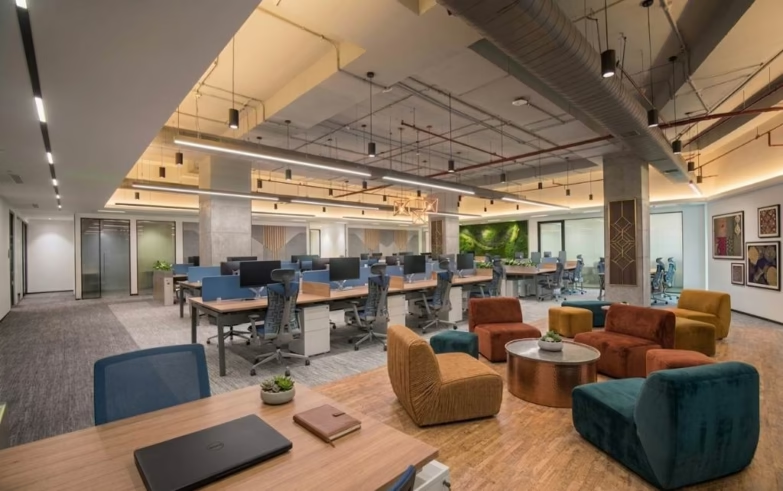
For years, office design in India was largely driven by aesthetics, how modern a space looked, how well it reflected a brand, and how impressive it felt to clients. But today, the conversation has shifted.
Workspaces are no longer just physical environments. They are performance ecosystems, carefully designed to influence how people think, collaborate, and deliver results. The link between office design and employee productivity is no longer theoretical; it’s measurable, visible, and increasingly critical for businesses across India.
From Gurgaon to Bangalore and Mumbai, organizations are rethinking how workplace design in India can directly impact efficiency, engagement, and overall output.
Why Office Layout Matters More Than Ever
At its core, office design is about behavior.
The way a workspace is structured influences:
- How often teams collaborate
- How easily employees can focus
- How comfortable and motivated they feel throughout the day
Traditional layouts—rows of desks, isolated cabins, and rigid seating, were designed for control, not performance. Today, modern office interior design in India focuses on flexibility and intent.
Businesses are moving towards:
- Open collaborative zones for teamwork
- Quiet focus areas for deep work
- Breakout spaces for informal discussions and mental resets
This shift reflects a deeper understanding: different tasks require different environments.
The Productivity–Design Connection
The relationship between office interiors and productivity is driven by multiple factors, many of which are often overlooked.
1. Focus vs Distraction
An open office without proper zoning can reduce productivity due to noise and interruptions. On the other hand, a well-planned layout balances openness with privacy.
2. Movement and Flow
Efficient layouts reduce unnecessary movement and friction. Employees can transition smoothly between tasks, meetings, and collaboration.
3. Comfort and Ergonomics
Ergonomic furniture, lighting, and ventilation directly impact physical well-being, which in turn affects performance.
4. Mental Well-being
Incorporating elements like natural light, greenery, and spacious layouts contributes to a more positive work environment, boosting both morale and productivity.
These factors are why employee-centric office design in India is becoming a priority for forward-thinking organizations.
The Rise of Human-Centric Workplace Design in India
Modern corporate office design in India is shifting from space utilization to experience creation.
Companies are now asking:
- Does the workspace support employee well-being?
- Does it encourage meaningful collaboration?
- Does it reduce fatigue and burnout?
This has led to the adoption of:
- Biophilic design elements (plants, natural textures)
- Flexible seating arrangements
- Wellness-focused zones and recreational areas
In high-pressure environments like Bangalore’s tech hubs or Gurgaon’s corporate offices, such design elements are no longer optional, they are essential for sustaining productivity.
Hyperlocal Influence on Workplace Productivity
Office design in India is also shaped by location-specific challenges.
- In Gurgaon and Delhi NCR, high real estate costs demand space optimization and multi-functional layouts
- In Mumbai, compact offices require high-efficiency design solutions
- In Bangalore, flexible and collaborative spaces dominate due to startup and tech culture
Understanding these nuances allows companies to create customized office interiors that align with both business needs and employee behavior.
At SLS Designs, this hyperlocal approach ensures that every workspace is not just visually appealing but also functionally effective and contextually relevant.
From Design to Performance: The SLS Perspective
At SLS Designs, office interiors are approached with a clear philosophy:
Design should drive performance.
Every workspace is planned with three core principles:
- Functionality: Ensuring every element serves a purpose
- Flexibility: Adapting to changing work styles and hybrid models
- Experience: Enhancing employee comfort and engagement
By integrating smart office design, sustainable practices, and human-centric layouts, SLS Designs creates environments that directly contribute to improved productivity.
Rather than treating design as a one-time project, it is viewed as an ongoing strategy that evolves with business needs.
Common Mistakes Businesses Make
Despite growing awareness, many organizations still approach office design with outdated thinking.
Here are some common mistakes:
- Prioritizing aesthetics over functionality
- Overcrowding spaces to maximize seating
- Ignoring employee feedback in design decisions
- Lack of zoning for different work activities
- Poor lighting and ventilation planning
These issues can significantly reduce the effectiveness of even the most visually appealing office.
What Businesses Should Focus On
To truly improve employee productivity through office design, businesses should:
- Create activity-based work zones
- Invest in ergonomic furniture and lighting
- Incorporate natural elements and open spaces
- Focus on layout efficiency and movement flow
- Design for both collaboration and concentration
The goal is not just to build an office, but to create a workspace that enables better work.
Conclusion: Designing for Behavior, Not Just Space
The future of office interior design in India lies in understanding human behavior.
Workspaces are no longer passive environments. They actively influence how employees perform, interact, and grow.
The question businesses need to ask is no longer:
“Does our office look good?”
But rather:
“Does our office help our people perform better?”
Because in today’s competitive landscape, productivity is not just a people problem, it’s a design opportunity.