
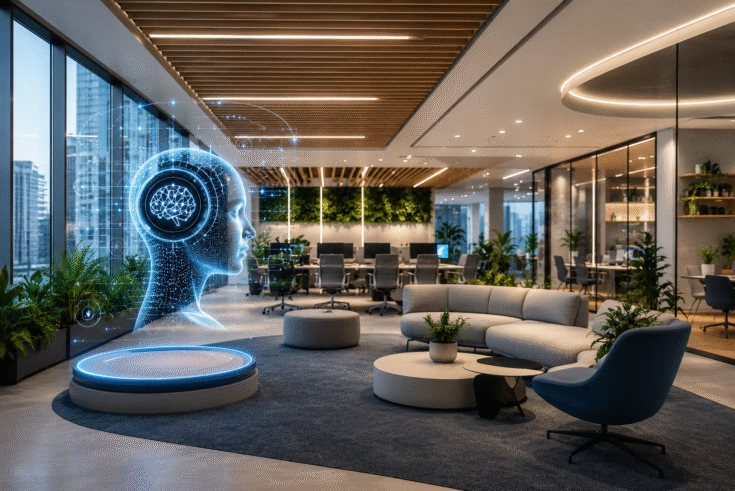
AI and the Future of Corporate Office Design
Artificial intelligence is changing how businesses operate, make decisions, and plan for the future. Now, its influence is extending into another important area: the workplace itself.
Traditionally, corporate office design was shaped by headcount, available space, departmental requirements, and brand aesthetics. Today, organisations can understand much more about how employees actually use their workplaces.
Which spaces are used most? When does occupancy peak? Are meeting rooms being used efficiently? Do employees need more collaboration areas or quiet spaces?
AI can help turn this information into meaningful design decisions.
From intelligent space planning and energy optimisation to personalised employee experiences, AI in corporate office design is creating opportunities for workplaces that are smarter, more responsive, and adaptable.
The future office will not simply look intelligent. It will learn how people use it and evolve with their needs.
From Space Planning to Intelligent Space Planning
One of the most practical applications of AI is smarter office space planning.
Traditional workplace planning often relies on fixed assumptions about how many employees need desks, how many meeting rooms are required, and how departments should be distributed.
Hybrid working has changed that equation.
A company with 1,000 employees may no longer require 1,000 permanent workstations. Different teams may visit on different days, meeting-room demand may fluctuate, and some spaces may remain underutilised.
AI-powered workplace analytics can help organisations study occupancy patterns, employee movement, meeting-room usage, and workspace demand.
For a corporate interior design company, these insights can support better decisions about allocating space for focused work, collaboration, meetings, social interaction, and flexible workstations.
Instead of designing offices purely around capacity, businesses can design around how people actually work.
Creating Workplaces That Respond to People
Imagine an office where lighting, temperature, meeting spaces, and environmental conditions respond intelligently to occupancy.
This is where AI connects with smart office design.
Connected technologies can gather information from sensors, building management systems, and workplace applications. AI can analyse this data to identify patterns and optimise the workplace environment.
Lighting can adjust according to daylight and occupancy. HVAC systems can respond to how different zones are being used. Meeting spaces can be managed based on real-time demand.
These improvements matter because employee experience is influenced by lighting, thermal comfort, acoustics, air quality, privacy, and access to the right workspace.
Technology can help designers understand these factors more precisely, but the objective remains human: creating environments where people can work comfortably and effectively.
Designing Around People, Not Just Floor Plans
Every organisation works differently.
A technology company may need collaborative project areas. A financial organisation may prioritise privacy and focused work. A hybrid organisation may require flexible neighbourhoods, technology-enabled meeting spaces, and fewer assigned desks.
There is no universal formula for the perfect workplace.
AI can analyse workplace data to better understand what different teams need. These insights can influence workstation ratios, meeting-room sizes, circulation planning, collaboration zones, acoustics, and employee amenities.
However, data should inform design, not dictate it.
Successful corporate office interior design will combine AI-powered intelligence with human-centred thinking. Technology can identify patterns, but designers must interpret them within the context of organisational culture, employee expectations, brand identity, and business strategy.
That human interpretation turns data into meaningful workplace experiences.
AI and Sustainable Office Design
Sustainability is becoming central to modern workplace development, and AI can help organisations approach it more intelligently.
Commercial buildings consume significant energy through lighting, cooling, heating, and equipment. When systems operate uniformly regardless of occupancy, resources can be wasted.
AI-enabled systems can optimise energy consumption according to real-time requirements. Areas with low occupancy may require less lighting or cooling, while predictive systems can help facility teams operate buildings more efficiently.
AI can also support sustainable office design before construction begins.
Advanced digital tools can help designers study daylight, compare layouts, evaluate environmental performance, and simulate design scenarios.
Combined with responsible materials, energy-efficient systems, biophilic design, and lifecycle planning, AI can help create workplaces that perform better both environmentally and operationally.
Generative AI Is Changing the Design Process
AI is also influencing how architects and interior designers develop ideas.
Generative design tools can explore multiple planning possibilities based on parameters such as floor area, circulation, daylight, workstation requirements, and collaboration needs.
This does not mean AI will replace designers.
Instead, it can make parts of the design process faster and more informed. Teams can test more possibilities, identify inefficiencies earlier, visualise concepts faster, and make better decisions before execution.
The real value comes from combining computational intelligence with professional expertise.
AI can generate possibilities. Designers give those possibilities context, creativity, functionality, and purpose.
The Future Office Will Learn and Evolve
Traditionally, an office was considered complete after construction and handover. AI could change that.
Future workplaces may continuously generate insights about how spaces perform.
Are collaboration areas being used effectively? Are some meeting rooms overcrowded while others remain empty? Which areas attract employees? Could energy use be optimised?
These insights can create a continuous feedback loop between workplace design, employee behaviour, and performance.
Rather than waiting years for another renovation, organisations could continually optimise existing spaces.
This shifts corporate interior design from a one-time project towards an evolving workplace strategy.
The Future of Corporate Office Design Is Human + Intelligent
The rise of AI does not make workplace design less human. It has the potential to make it more informed about humans.
The future of corporate office design will bring together intelligent technology, sustainability, employee wellbeing, flexibility, and thoughtful design.
At SLS Designs, we believe the next generation of workplaces will combine technology with human-centred design to create environments that are flexible, sustainable, functional, and aligned with evolving business needs.
The most successful offices will not be defined by how much technology they contain, but by how intelligently that technology improves the experience of the people using them.
Because the future is not simply an AI-powered office.
It is a workplace that understands why, where, and how people work best.
Frequently Asked Questions
How is AI changing corporate office design?
AI helps organisations analyse occupancy, space utilisation, employee behaviour, and environmental data to make more informed design decisions. This can improve space planning, energy efficiency, workplace flexibility, and employee experience.
What is an AI-powered smart office?
An AI-powered smart office uses connected technologies, data, and artificial intelligence to optimise functions such as lighting, temperature, energy consumption, meeting-room usage, and occupancy based on real-time requirements.
Can AI make offices more sustainable?
Yes. AI can optimise energy consumption, HVAC systems, lighting, and space utilisation. During the design process, digital tools can also help evaluate layouts, daylight, and environmental performance to support more sustainable workplace decisions.
Will AI replace corporate interior designers?
AI is more likely to enhance rather than replace designers. It can analyse data, explore layouts, and accelerate visualisation, while designers provide creativity, strategic thinking, cultural understanding, and human-centred expertise that technology alone cannot replicate.