
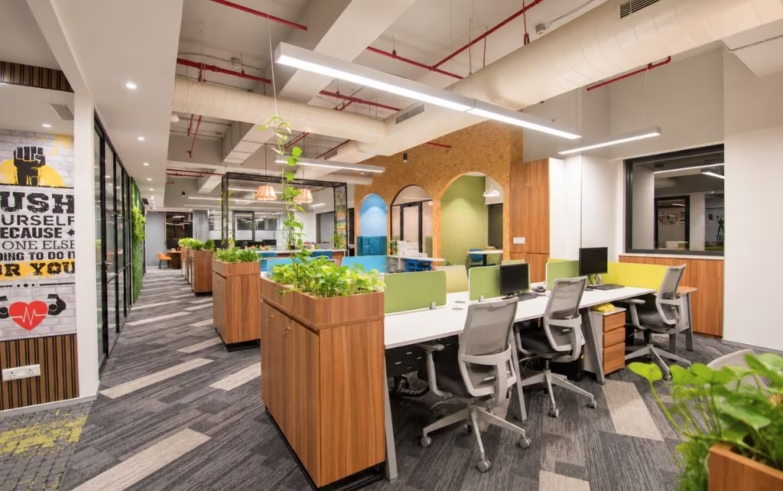
Twenty years is more than a milestone. In an industry as dynamic as workplace design, it represents two decades of learning, adapting and understanding how businesses and their people use space.
For SLS Designs, the journey of two decades has been closely connected with the evolution of corporate interiors in India. From traditional office environments to today’s flexible, technology-enabled and experience-driven workplaces, the expectations from corporate spaces have changed significantly.
What was once considered primarily a functional requirement has increasingly become a strategic business consideration. Today, an office can influence employee experience, collaboration, productivity, brand perception and even how an organisation attracts and retains talent.
Over the past 20 years, SLS Designs has evolved alongside this transformation, working across corporate workplaces and developing an understanding of what businesses need from their physical environments.
From Office Spaces to Workplace Experiences
Corporate office design has changed considerably over the last two decades.
Earlier, office planning often focused on efficiently accommodating teams, meeting basic functional requirements and maintaining a professional appearance. Today, organisations are looking at workplaces through a much broader lens.
Workplace design now considers how employees collaborate, concentrate, interact, learn and connect. Meeting rooms need to support different types of conversations. Workstations need flexibility. Common areas need to encourage interaction. Acoustic planning has become increasingly important, while lighting, material selection and ergonomics contribute to overall workplace experience.
This shift has changed the role of corporate interior design.
It is no longer simply about creating an attractive office. It is about creating an environment that supports the way an organisation operates.
For an experienced corporate interior design company in India, understanding this evolution is essential. Every organisation has its own culture, business model, workforce and operational requirements. The workplace needs to reflect those realities rather than follow a standard template.
Designing for Changing Business Needs
One of the biggest lessons from two decades in corporate interiors is that there is no single definition of the ideal workplace.
A technology company may require highly collaborative spaces and agile work zones. A financial organisation may prioritise privacy, security and focused work. A multinational company may need to balance global workplace standards with local requirements.
This is where workplace strategy becomes an important part of the design process.
Before selecting materials, furniture or finishes, it is important to understand how the organisation works.
How do teams interact?
How much collaboration is required?
Where do employees need privacy?
How frequently are meeting spaces used?
What role does technology play?
How could the workplace adapt as the business grows?
These questions help transform an office project from a purely physical exercise into a more considered business solution.
The Growing Importance of Sustainability
Sustainability has also become an increasingly important part of corporate office interiors.
Businesses today are more conscious of material selection, energy consumption, indoor environmental quality, waste management and the long-term performance of their workplaces.
Sustainable office design is therefore not limited to adding plants or choosing a particular visual aesthetic. It can involve decisions across the entire project, from materials and lighting to energy efficiency, durability and responsible sourcing.
The concept of material intelligence is particularly relevant here. Materials influence more than appearance. They affect acoustics, maintenance, durability, comfort and the overall environmental performance of a workplace.
The opportunity lies in making design decisions that balance aesthetics, functionality, employee wellbeing and long-term value.
A Japanese Perspective on Workplace Design
SLS Designs’ experience with Japanese companies in India adds another dimension to its understanding of corporate workplaces.
Japanese organisations often bring a distinct approach to workplace planning, with strong attention to order, efficiency, quality, functionality and detail. At the same time, their Indian workplaces need to operate effectively within local business, cultural and regulatory environments.
Designing a Japanese corporate office in India therefore requires more than replicating a design language.
It requires understanding the organisation’s working culture while adapting the workplace to local needs.
Elements such as spatial efficiency, meeting room planning, hierarchy, privacy, storage, material quality and attention to detail can become particularly important. The objective is to create a workplace that feels aligned with the organisation while remaining practical for employees working in India.
This cross-cultural understanding has become an important part of SLS Designs’ experience in the corporate interiors segment.
Designing for People, Not Just Spaces
Another significant change has been the growing focus on employee experience.
The modern workplace needs to accommodate different working styles and different moments within the working day. Employees may need spaces for focused work, informal discussions, collaboration, meetings or simply taking a break.
This has brought concepts such as wellness, acoustics, ergonomics, biophilic design and employee experience further into the corporate interior conversation.
Good workplace design does not necessarily mean adding more features. It means understanding which features genuinely support the people using the space.
A well-planned workplace can reduce friction, improve usability and create a stronger connection between people and the organisation.
20 Years of Learning and Looking Ahead
Two decades have also reinforced an important principle: workplace design cannot remain static.
The next generation of corporate interiors will be influenced by artificial intelligence, hybrid work, smart building technologies, sustainability requirements and changing employee expectations.
Technology will continue to change how workplaces operate, but the fundamentals of good design will remain relevant: understanding people, understanding business, and creating spaces that work.
For SLS Designs, reaching 20 years is therefore not simply about looking back. It is an opportunity to reflect on how corporate interiors in India have evolved and how workplace design can continue to create meaningful value for businesses.
From functionality to experience, from conventional offices to flexible workplaces, and from local requirements to increasingly global workplace expectations, the industry has come a long way.
The next chapter will require the same willingness to learn, adapt and rethink what a workplace can be.
Twenty years have shaped the experience. The next twenty will shape what comes next.
FAQs
What is corporate interior design?
Corporate interior design involves planning and designing workplaces around an organisation’s functional, operational, cultural and employee requirements.
How has corporate office design changed in India?
Corporate offices have evolved from primarily functional environments to more flexible, technology-enabled and employee-focused workplaces.
What should companies consider when designing a corporate office?
Companies should consider workplace strategy, space planning, employee experience, acoustics, technology, sustainability, ergonomics, brand identity and future growth.
What are Japanese corporate office design considerations in India?
Japanese corporate offices may require particular attention to efficiency, quality, spatial planning, functionality and cultural working practices while adapting to Indian operational requirements.
Why is sustainability important in corporate interiors?
Sustainable design can help organisations make more responsible decisions around materials, energy, indoor environments, durability and long-term workplace performance.